
Pressure Swing Adsorption, or PSA, is widely used across industries for the separation and purification of various gas products, including hydrogen, methane, carbon dioxide, carbon monoxide, helium, oxygen and nitrogen.
SWCHEM began its research and development in PSA gas separation technology in 1972 and is a pioneer and leader in PSA technology in China. Over decades of continuous innovation and industrial application, SWCHEM has developed a broad portfolio of PSA technologies and built the largest industrial reference base in the field.
PSA technology is one of SWCHEM's core businesses. With long-standing expertise in gas separation process engineering, industrial off-gases treatment and resource recovery and utilization, SWCHEM provides reliable PSA solutions for various industrial applications.
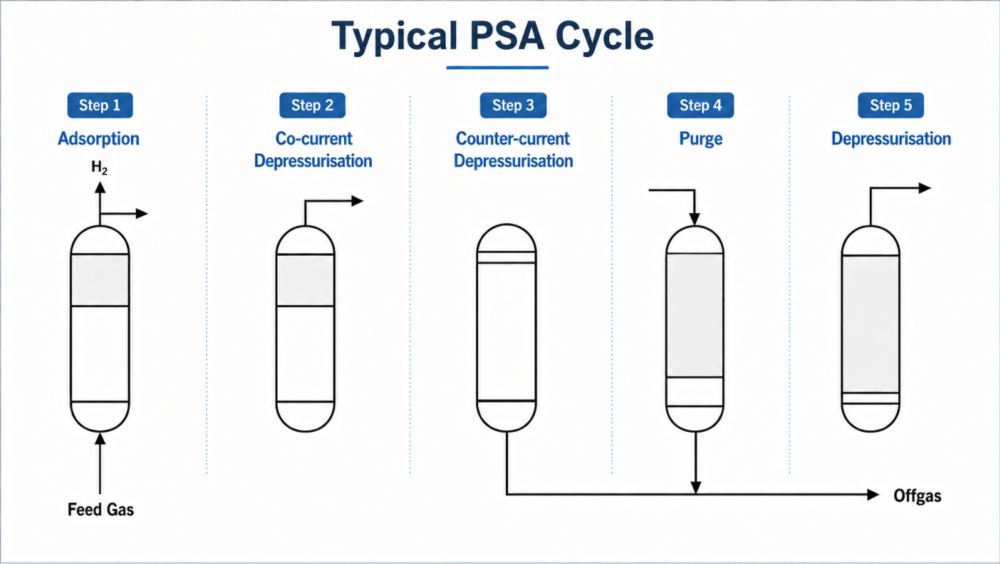
PSA is a cyclic separation process that uses differences in the selective adsorption of gas components on solid adsorbents at different pressures to achieve the separation of different components.
Taking PSA-H2 as an example, a H2-rich feed gas is introduced into adsorption vessels at elevated pressure. Impurities such as CO, CO2, CH4 and N2 are selectively adsorbed on solid adsorbents, such as molecular sieves, while H2 passes through the adsorber and is delivered as the product gas.
The process is typically operated at ambient temperature, with an adsorption pressure generally ranging from 10 to 60 bar. Multiple adsorption vessels, or adsorbers, are arranged to operate in sequence. While one adsorber is in the adsorption step, other adsorbers are in regeneration or preparation steps.
SWCHEM's PSA technologies are used for the recovery, purification and enrichment of a wide range of industrial gases.
SWCHEM provides integrated PSA technologies and engineering services to support customers from project development through to long-term plant operation.
Our capabilities include:
| No | Type | Qty | Plant Capacity | Product Purity |
|---|---|---|---|---|
| 1 | H₂ separation and purification | 1169 | 20~400,000 Nm³/h | 98.5~99.9999% |
| 2 | CO₂ separation and purification | 98 | 10,000~300,000 t/y | 99.5~99.99% |
| 3 | CO separation and purification | 47 | 100~30,000 Nm³/h | 96.0~99.9% |
| 4 | CO₂ removal from shift gas | 218 | 1,500~220,000 Nm³/h | CO₂ : 1~2,000ppm |
| 5 | Natural gas purification | 42 | 1,000~80,000 Nm³/h | C₂+<100ppm |
| 6 | N₂ separation | 109 | 20~12,000 Nm³/h | 99.0%~99.999% |
| 7 | O₂ separation from air | 15 | 200~10,000 Nm³/h | 93% |
| 8 | CH₄ concentration from landfill gas | 8 | 500~50,000 Nm³/h | CH₄>95% |
| 9 | Helium separation and purification | 11 | 10–100 Nm3/h | 99.9–99.9999% |
| 10 | Ethylene concentration | 14 | 1,200~50,000 Nm³/h | C₂+>85% |
| 11 | VCM tail-gas purification | 35 | 500~3,000 Nm³/h | C₂H₃Cl<36ppm |
| Total | 0 |

